
"Show your workings!"
Teachers and parents consistently use this expression... but why should we ask pupils to do this?

If you talk to almost any parent of a primary or secondary child, you’ll hear the same phrase: “Make sure you show your working out.”
It’s a familiar mantra, but where does it come from? And is it still really necessary?
This question came up for me recently while running an after-school club with parents in a primary school. The parents repeated that phrase, almost instinctively: you need to show your working to pick up those extra marks.
And yet, when we looked at the arithmetic paper in the SATs, something struck me: the vast majority of questions are worth just one mark. They don’t require any working whatsoever. So why has this phrase stuck around, especially among the older generation?
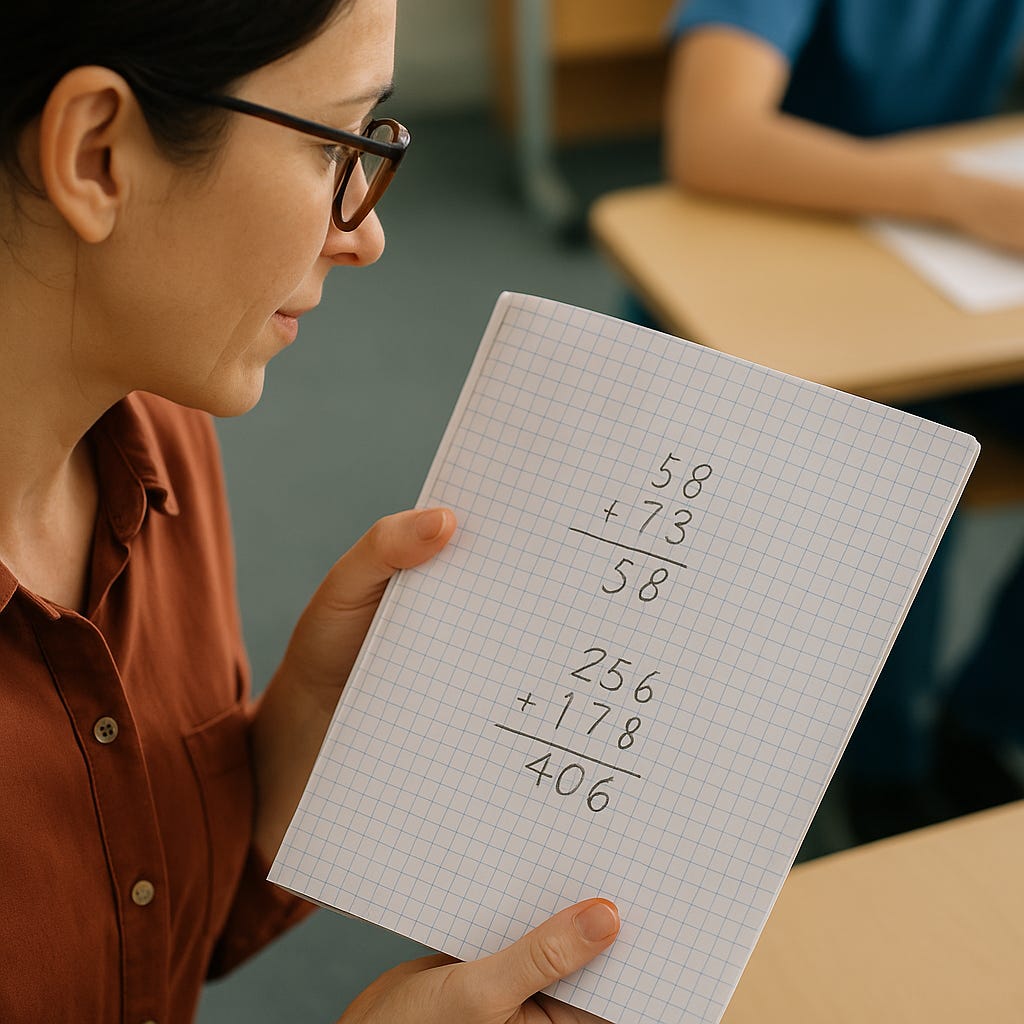
When does working out matter?
There have certainly been cases in recent years where students have passed GCSE maths almost entirely on method marks—without getting many final answers correct. That’s one reason parents might repeat the advice.
But for me, the real value of showing your working has very little to do with exams.
Too often, maths education is seen through the narrow lens of “passing the test.” Parents (and, sometimes, schools) fixate on grades: Get the mark. Get the qualification. Of course, maths qualifications matter. But that isn’t why showing working is important.
Working out is thinking out loud
For teachers in classrooms, showing working is about insight, not marks. An answer on its own tells us almost nothing. The steps a child has written down, however, tell us what’s going on inside their head.
Did they understand the problem in the right way?
Did they choose an efficient strategy?
Did they get stuck at a particular step?
Can they explain why they did what they did?
These glimpses into a child’s thinking are what allow teachers to intervene, ask good questions, and move learning forward.
It’s less about proving correctness and more about making reasoning visible.
Beyond the exam hall
Exams last a few hours at the end of years of study. Working out, though, matters across the whole journey of learning maths. When children share their steps, they’re not just ticking boxes for marks—they’re building habits of explanation, communication, and reflection.
And that’s not only valuable in maths. The EEF talk about “metacognition”—the ability to reflect on and regulate your own thinking. Studies show that when pupils explain their reasoning, they learn more deeply and retain concepts for longer. Showing working is, in effect, practising metacognition.
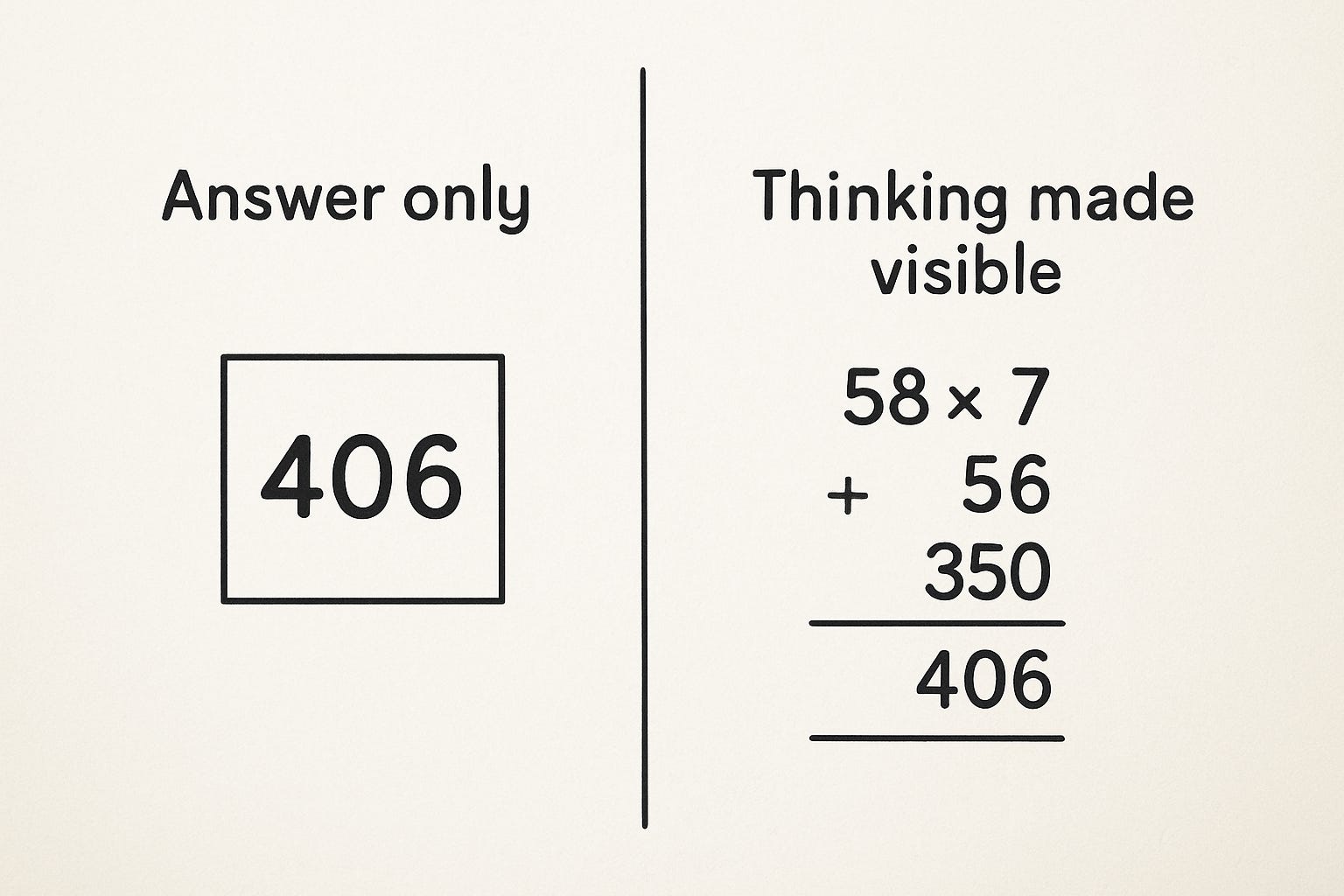
A shift in emphasis
So yes, it’s important that children show their working. But the emphasis shouldn’t be on squeezing out a few extra marks. It should be on helping children develop as thinkers.
The next time you hear someone repeat the phrase “Show your working out”, maybe it’s worth adding an extra sentence: “...because your thinking matters more than the answer.”
I agree entirely with this, and it's a problem I see in maths teaching all the time. Pages of ticked or occasional crosses of numerical answers, answer sheets just the numerical answer not the method. Just like with @sarahcottinhatt and @adamkolhbeck and their use of mental model mapping in coaching, as teachers we want to be sure we have developed robust and precise generative models of how to solve something, or a knowledge schema. In my view students should never feel they got the answer right during practice if they didn't have the steps of the method used correct. Several different methods maybe ok... But the teacher and the students should know is their updated generative model good and solid.