
"Culture Eats Strategy for Breakfast" – A Visit to The Totteridge Academy
Earlier in the week, I’d heard someone use the phrase, "Culture eats strategy for breakfast." Two days later, I saw it in action and it is SO true!

I had the privilege of spending a day at The Totteridge Academy thanks to Ban Kubba, the former Head of Department (thanks so much, Ban!). If you haven’t seen the school’s data… it is off the chart! Their last official progress 8 score for maths was +1.52 and with other departments performing equally as well, it is one of the highest-performing schools nationally for pupil progress. Impressive as that statistic is, what fascinated me wasn’t the data…. it was the culture.

The culture appeared to me before I had even stepped into a classroom.
Staff gathered together for “Thought for the Day,” giving them time to reflect on mental wellbeing before the day’s announcements. During those announcements, the school leader mentioned that I was visiting for the day. Instantly there was a genuine cheer and applause.
It wasn’t false and nothing to do with me. It wasn’t pre-planned or manufactured – it was simply what they do when someone visits their school…. And as well they should welcome people into their school, because what I then went on to see throughout the day was remarkable.
Actually, perhaps remarkable isn’t quite the right word…. Everything I saw was familiar.
We know about Rosenshine. We know about Teach Like a Champion. Many may say they teach using strategies such as cold call, call and response and developing a culture of error. We hear these ideas discussed with trainee teachers and schools across the country.
But simply knowing about these strategies doesn’t mean they’re implemented well.
When I spoke to the Assistant Principal responsible for Teaching and Learning, he said something incredibly simple…
“We do what we say we do.”
That sentence stayed with me for the rest of the day.
When they say they use cold call, they use cold call…. properly. Consistently. In every lesson I visited. Across the school, cold call was nailed.
Across the school, a culture of error wasn’t simply accepted by teachers; it was embraced by pupils too. If someone gave an answer that wasn’t quite right, or perhaps could be upgraded, pupils quietly raised their hands. The teacher paused, looked around the room and asked whether anyone else had spotted something.
Mistakes aren’t embarrassing but become opportunities for learning, as it states in the mathematics department handbook:
“Engaging with mistakes… further deepens conceptual understanding, as students must be able to explain why they are wrong. This trains them in the discipline of thinking like a mathematician.”
You could see this culture everywhere! Pupils discussed their thinking with one another. They tried to convince each other why an answer was correct or incorrect. They created top tips together when correcting work. They even wrote questions for one another to practise in small groups so they could improve areas they hadn’t yet mastered (see below).

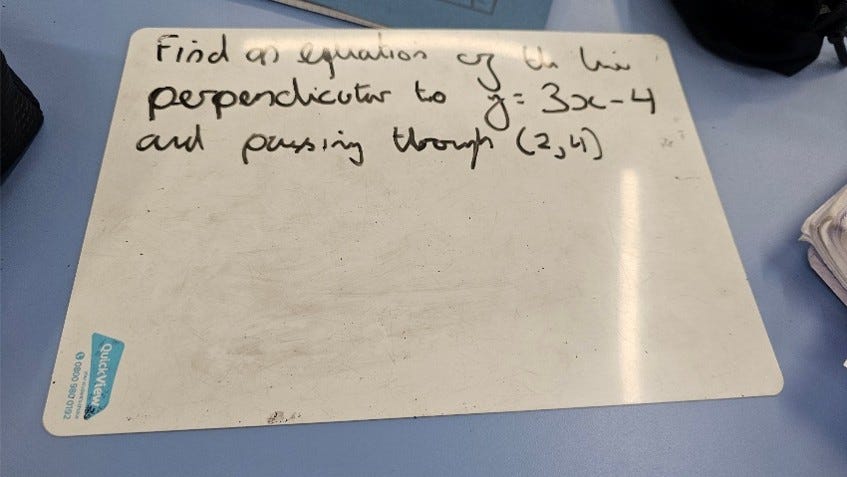
I’d be fascinated to visit again in September to see how this culture is established with the new Year 7 cohort, because by the time I visited in June it was completely embedded.
Collaboration amongst staff
The culture of collaboration wasn’t confined to the classroom either. It existed just as strongly amongst the staff. Again, I found myself coming back to the phrase, “We do what we say we do.” That consistency was obvious in every lesson I observed.
Department handbooks (each department given autonomy to write their own) weren’t simply documents that sat on a shelf. They were clearly the product of deep professional discussion / debate. What is the TTA way in maths and how do we want to enact it?
Part of this is agreed methods for topics - teachers won’t always agree on every method, and nor should they. But what struck me was that everyone understood the greater good and that a decision will be made that everyone will stick to. Children should be able to move from one classroom /set to another and receive the same diet, the same methods and the same expectations. That consistency allows pupils to focus on learning rather than adapting to a different teacher’s way of working.
In mathematics, considerable thought had gone into choosing methods that would best support pupils over their five-year journey, including relying heavily on the box method when exploring multiplicative relationships (see below) and as such, there is a huge focus on TimesTables RockStars in year 7 to ensure pupils can successfully use the box method through the school.

One thing I haven’t mentioned yet is that this culture extends to professional learning as well. There is a genuine culture of continuous improvement or “kaizen” – a word I heard discussed during my visit.
Teachers visit one another’s classrooms regularly with an open-door policy. Anybody can walk in to observe a lesson, regardless of role or experience. Afterwards, staff discuss what went well and what could be even better. But this isn’t hierarchical. The least experienced teacher will offer WWW and EBI feedback to the most experienced member of staff, because everyone understands that the purpose isn’t judgement. It’s continual improvement. It’s kaizen!
The impact of CHANTS!
One major feature of the department’s growth is the focus on the use of chants (or “Call and response”)
Volume is...
“The space inside a 3D shape.”
Perimeter is...
“The distance around a 2D shape.”
Angles in a triangle add up to...
“180 degrees.”
Yes fine, year 7 responded with slightly more enthusiasm than Year 9…. but Year 9 still responded, and if the teachers weren’t happy with the quality or energy of the response, they simply asked again. These are fabulous ways of ensuring recall of mathematics knowledge and facts. I even saw one teacher tell pupils to make up their own chant following the work – the pupils are being asked to generalise which delighted me!
But these chants weren’t confined to mathematical knowledge either. They were also about learning behaviours.
I heard one teacher say “The quickest way to learn...” and the pupils replied “…is to ask questions.”
Another teacher used a slight variation. “The most important thing for learning is...” Again, the pupils responded, “…to ask questions.”
These chants are teaching pupils how to learn and to have ownership of their learning, both individually and collectively.
Perhaps my favourite moment of the day came where a teacher noticed that one pupil was struggling while another pupil nearby understood the work perfectly. I expected the teacher to go straight over and help the pupil who was struggling. Instead, the teacher turned to the other pupil and simply asked “Why didn’t you help him?”
That one sentence said so much about the culture of the school. The expectation wasn’t simply that teachers help pupils. The expectation was that not only do the pupils own their own learning but they have a responsibility for each other’s learning. This shows how collaboration is key at all levels: within the staff and within the classroom. It’s part of what it means to belong to the school.
Looking deeper at how the ownership of learning is with the pupils, I enjoyed how one teacher explained to the class that tests weren’t about proving what they already knew. The purpose of a test was to identify what they didn’t yet know. The learning came afterwards, when mistakes were reviewed and gaps were closed. The teacher then referred back to previous classes and the different outcomes achieved by pupils who had genuinely applied themselves compared with those who hadn’t. The message was clear…. effort matters.
Not because teachers say it does, but because effort changes outcomes.
Summary
I’ve often said that a collection of great teachers is very different from a great collection of teachers.
A great collection of teachers shares a vision with shared principles, methods, expectations and shared ownership of the five-year journey every child takes through the school.
That is exactly what I saw at The Totteridge Academy.
The consistency of delivery, questioning, expectation, collaboration that the team have worked hard at over time to create. It genuinely blew me away.
I even saw it on one of the classroom walls - “The team is more important than the individual” – this culture clearly applies at all levels at TTA.
“Culture eats strategy for breakfast.” – Damn right it does!

I love the idea of this kind of culture. I've been trying to work like this for years. The part of your article that tells of a teacher spotting a struggling kid and getting another kid to help brought back an amusing incident for me. I was covering a maths class for a few months and did exactly as described above. The Head of Maths got an email the next day from the parent of the helper kid complaining that I wasn't doing my job and that her kid's time was being wasted. That's the impact of a school's culture right there.
This level of consistency and the emphasis on school culture reminded me a lot of a visit I made to Michaela Community School recently, which I hope to write about soon. They're obviously very different schools but the consistency across classrooms was one of my biggest takeaways there too. The focus on effort as opposed to simply celebrating success also seems like a strong point of overlap as well.
Your piece particularly resonated as I'm actually in the middle of a school visit project myself, spending time in schools across the UK to understand what makes them distinctive, so I found this a fascinating read. Out of curiosity, do you happen to have a contact at Totteridge that you could point me towards? I'd love to see the school for myself at some point in the future. And if you're familiar with Michaela, I'd be really interested to know whether you noticed some of the same parallels. Many thanks again for sharing your experience at this interesting school